Features:
We asked where journalism gatherings go wrong: Here’s what we heard
Responses from our conversation to develop a baseline for evaluating conference success.
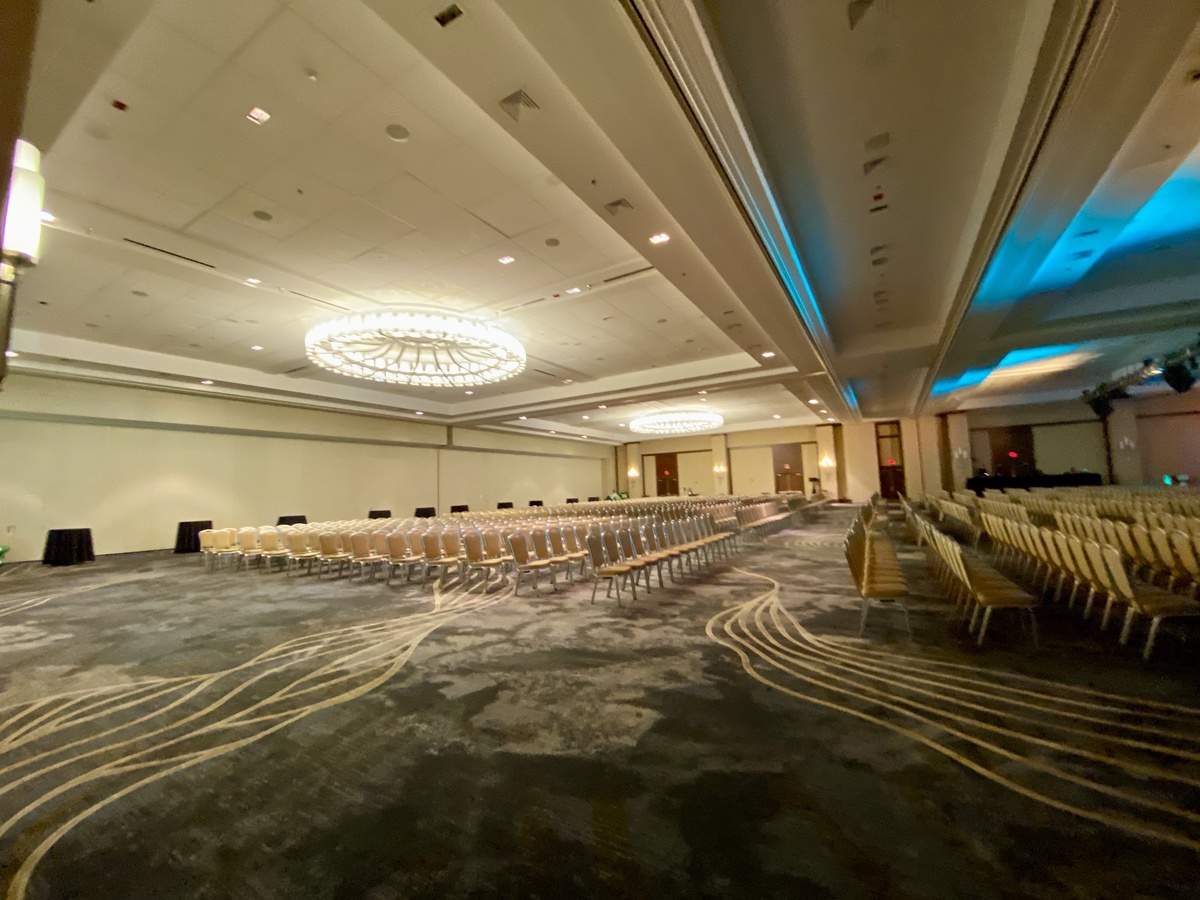
An empty room at a conference. (Patrick Boehler)
A few weeks ago, we published an article arguing that journalism gatherings have a closed-loop problem: the same speakers presenting the same slides about the same problems to the same audiences, while the people doing the most interesting work are often absent from the stage with no entrypoint.
We asked OpenNews and its community, drawing on their experience running SRCCON, to help us facilitate this conversation and begin developing a baseline for evaluating conference success. On February 26, about 15 conference organizers, independent journalists, data reporters, community managers, and media consultants joined an OpenNews community call to share their experiences and begin to brainstorm solutions (Thank you!!). What follows draws on themes from the discussion and comments shared before and after, without attributing comments to individuals.
The conference before the conference
Several people on the call named a practice most of us have experienced but rarely talk about: the public listing of invitation-only side events at conferences. The result is immediate status sorting. You arrive and start working back-channels to figure out which unlisted gatherings you should try to access. One participant put it well: the conference becomes a city you have to navigate before you can be present at the event.
Priya Parker writes about this in The Art of Gathering (a book recommended to us after our first article!): without explicit rules, people default to etiquette, and etiquette favors the aristocracy. When the real opportunities happen in rooms you weren’t invited to, and everyone knows it, the main event becomes a second-tier experience for everyone who isn’t already connected.
The closed loop, confirmed
We previously described a speaker selection cycle where people get invited because they’re known, and they’re known because they were invited. The call confirmed this isn’t just our observation. People described speaker slots functioning as a networking tool for organizers rather than a learning tool for attendees.
This gets worse in a contracting industry. The pool of active practitioners gets smaller. The same names circulate. And several people added a detail we hadn’t fully accounted for: experienced practitioners are opting out of conferences entirely. The people best positioned to push for change are leaving because the return isn’t there anymore.
That creates a real tension. For early-career journalists, even a panel-heavy conference with familiar speakers provides real value: new exposure, networking, professional socialization. For mid-to-late career practitioners, these same events offer less each time. Designing for both is hard. Default to entry-level content and you drive out the experienced people. Dismiss the content as old news and you alienate newcomers. Nobody wins.
Attendees discussed that this created a greater need for transparency and clarity on who events are for and who can benefit from them, to better help align expectations and matchmaking of attendees and events. This led to the development of a criterion for conference success: a conference is successful if it achieves what it sets out to do and serves whom it sets out to serve.
The boundary problem
Several people noted that conferences define journalism too narrowly. Creators, community practitioners, and others doing journalistic work outside traditional institutions get excluded. And this works against the industry’s own interests: the people doing the most novel work in information and community are often outside it.
One participant described a community creator who attended a local journalism summit hoping to connect and learn, only to find the entire day was panels with no entry point for participation. We heard something similar at the civic journalism conference we wrote about last month: people arrive wanting to contribute and leave feeling shut out.
We know how to do this. We just don’t do it for ourselves.
This was maybe one of the most useful observations from the call: Journalism has developed methods for gathering input from audiences, understanding community needs, and building feedback loops. Audience research, user testing, community listening sessions. These are standard practices now.
We don’t see these or similar methods widely applied to how journalism organizes its own professional gatherings.
The profession that teaches others how to listen to their communities does not listen to its own. Several people raised this independently, which suggests it’s not a few people’s blind spot but a structural one.
The feedback vacuum
There is no functioning mechanism for honest assessment of journalism conferences. Post-event surveys collect testimonials, not evaluations, and not shared broadly. There is no public data on whether sessions led to changes in practice. There is no structure for sharing constructive feedback without it being received as an attack.
Without feedback, conferences can’t improve, and we can’t assess what they’re helping or hurting. And the incentives work against improvement: organizers who take risks with new formats and invite honest assessment will look worse on paper than those who coast on friendly audiences and collect glowing quotes. The system rewards polish and penalizes transparency.
What could work better?
Participants shared practices they’ve been a part of that could improve gatherings:
1. Multi-round speaker development before the event. At one digital conference, pitches go through three feedback rounds with other presenters. This filters out speakers too set in their material to engage with critique, and creates a cohort that’s prepared to learn from each other, and a more cohesive conference program
2. Pre-event surveys that surface misconceptions. Not just collecting preferences but establishing shared data about the actual state of play. Ground the event in reality before people walk in the door.
3. One-on-one consultation sessions. Attendees book time with experts to discuss specific problems privately. This helps people who won’t raise issues in a group setting. In a contracting industry where asking for help feels risky, that’s a lot of people.
4. Speaker mentorship programs. The Outlier conference from the Data Visualization Society pairs first-time speakers with experienced presenters. This builds the pipeline instead of just drawing from it.
5. Problem-based sessions. Speakers bring problems, and the audience brainstorms solutions. This reverses the usual dynamic where the stage has answers and the audience consumes them.
6. And one that sounds obvious but isn’t common practice: attending non-journalism conferences. Creator conferences, data visualization events, community organizing convenings. Bring ideas back from adjacent fields instead of recycling our own.
The open questions
Many solutions we had operated at the program-level, but we know that problems we identify span beyond to structural, equitable concerns. We don’t want to pretend we have this figured out. Some hard problems came up on the call that don’t have obvious answers:
1. Expansion without any boundary-setting creates its own problems and can invite bad actors. If we expand participation to include creators and non-traditional practitioners, how do we align community standards?
2. Conferences are a major revenue source for organizing bodies. If registration income depends on big-name speakers, what alternatives exist?
3. The multi-round speaker development process works well but is labor-intensive. Can it scale beyond small, curated events?
4. Multiple participants said they skip registration and just network in the lobby. What does this say about the value proposition of conference content that organizers need to hear?
5. And a geographic question: some said they were now prioritizing speaking at events about what’s happening in their region, which has been historically underserved by journalism gatherings. What would a deliberate geographic redistribution of events look like?
How do you decide which conferences to attend or skip?
If you have answers, or better questions, we want to hear them. We hope we can find a way to better collectively share and assess conference experiences.
Join the conversation in #events in the News Nerdery Slack or reach us at better-gatherings@gazzetta.xyz.
Editor's note: OpenNews publishes Source and convenes the SRCCON conference.
Credits
-
Patrick Boehler
Patrick Boehler has accumulated more conference lanyards than he'd like to admit. He runs Gazzetta, a media research lab studying how people access information in restrictive environments, and writes the re:filtered newsletter. Before that, he spent years as a reporter, editor, and newsroom manager in Asia and Europe. He lives in Brooklyn and is trying to attend fewer panels.
-
 Madison Karas
Madison Karas is the Lead for Service Design at Gazzetta. She works on product and research initiatives for independent media organizations and has spent a lot of time in startups and too much time at conferences. She is exploring how service design, cooperative models, and more robust contribution systems can build a better, more intentional future for journalism producers and consumers.