Features:
What journalist-parents ask for, and what they don’t
Finding community and solidarity: notes from a SRCCON 2026 session
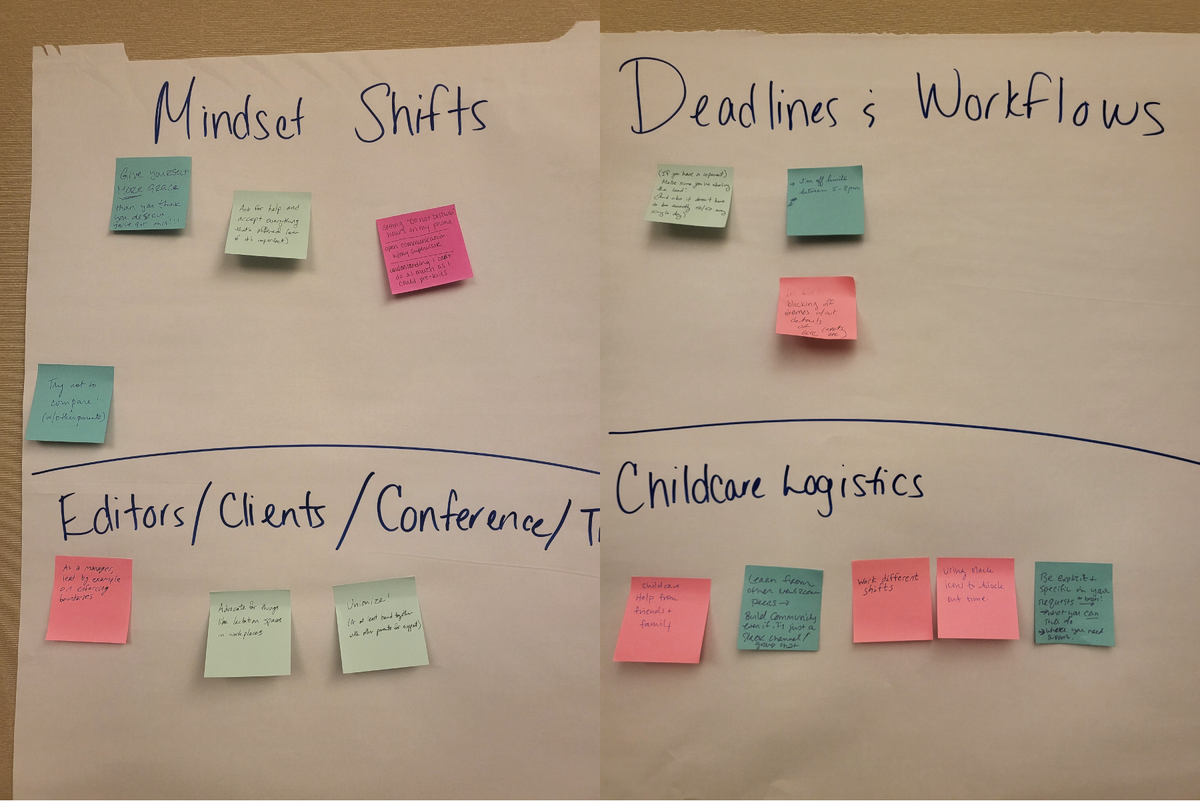
Post-it notes organized during the SRCCON 2026 session. (Tasmiha Khan)
Journalism is demanding. Caregiving is demanding. Doing both at the same time, especially with young kids, can feel isolating in ways that are hard to name out loud. That was the premise of the session André Natta and I facilitated at SRCCON this year: a space to name it, then to move into problem-solving together.
We asked the room a simple question. What has actually helped you do both jobs at once? People wrote their answers on sticky notes, and we sorted them together on the wall into rough categories: deadlines and workflows, childcare logistics, mindset shifts, and editors, clients, and conferences.
Two columns of responsibility: one overflowing and one nearly empty
What struck me afterward was the distribution.
Almost every note was something a caregiver does to themselves or inside their own household. Block off 5 to 8pm. Work different shifts than your co-parent. Use your Slack icon to block out time. Give yourself more grace than you think you deserve. Ask for help and accept everything that’s offered, even if it’s imperfect. Try not to compare yourself to other parents. Set “Do Not Disturb” hours on your phone. Understand that you can’t do as much as you could pre-kids.
These are real and useful. But look at where they live. They are private negotiations, made by one person with their own calendar, their own phone settings, their own sense of guilt to manage.
The column where institutions carry any responsibility, meaning editors, clients, or the conferences and organizations that structure our work, had almost nothing on it. Three notes. Two of those three still put the labor back on the caregiver: advocate for lactation spaces in workplaces, unionize, or at least band together with other parents for support. Only one, “as a manager, lead by example on enforcing boundaries,” asked something of a person with actual power over someone else’s workload.
That near-empty column is the story. Ask a room of journalist-parents what’s helped and they answer with self-management, because the industry has quietly privatized a structural problem. People have so thoroughly absorbed that no help is coming that they don’t think to ask for it.
This isn’t only a journalism problem, and it’s worth saying so plainly. The National Alliance for Caregiving and AARP found that 63 million Americans, nearly one in four adults, provided ongoing care for a family member in the past year, an increase of 20 million people in a single decade. That’s not a niche accommodation for a handful of employees. That’s a quarter of the adult population quietly managing a second, unpaid job on top of their first one, largely without their employer’s help. Journalism just happens to be the industry I know well enough to show my work in.
I should be honest about one thing. We asked what has genuinely helped, which is a question about coping, and a question about coping will tend to produce answers about coping. I don’t think that fully explains the imbalance, but it’s a fair caveat, and one worth sitting with rather than glossing over.
So what belongs in that empty column?
For editors and the people who hire freelancers: caregiving isn’t a liability, it’s information you can plan around. A freelancer telling you she has young kids and no institutional backup is handing you a scheduling constraint, not a reason to think twice about the pitch. If you manage people, enforce boundaries by example, not just by policy, the way one lone sticky note on our wall asked for.
For conferences and industry organizations: normalize childcare stipends and alcohol-free social spaces as a baseline, not something someone has to request in a form’s fine print.
One more note from the wall, written without any prompting from André or me: build community even if it’s just a Slack channel or group chat. Somebody in that room reached for peer infrastructure on their own, before we ever asked for it. That’s the hopeful reading of an otherwise sobering wall. Left to fend for itself, our industry keeps discovering it needs to build the support it isn’t getting handed to it, and journalism is far from alone in that. With a quarter of American adults now doing this kind of caregiving, every industry has a version of this wall sitting somewhere, mostly unwritten. The least any of us can do is stop making self-management the only option.
Credits
-
Tasmiha Khan
Tasmiha Khan is a mother of three and passionate about caregiving as she traverses broken systems to support moms. A passionate storyteller, Tasmiha also has her debut picture book, “What is a Tupi?” coming out in 2027.