
Features:
We asked a whole journalism conference what it wanted, out loud
At SRCCON in Minneapolis this July, we got to run a small test.
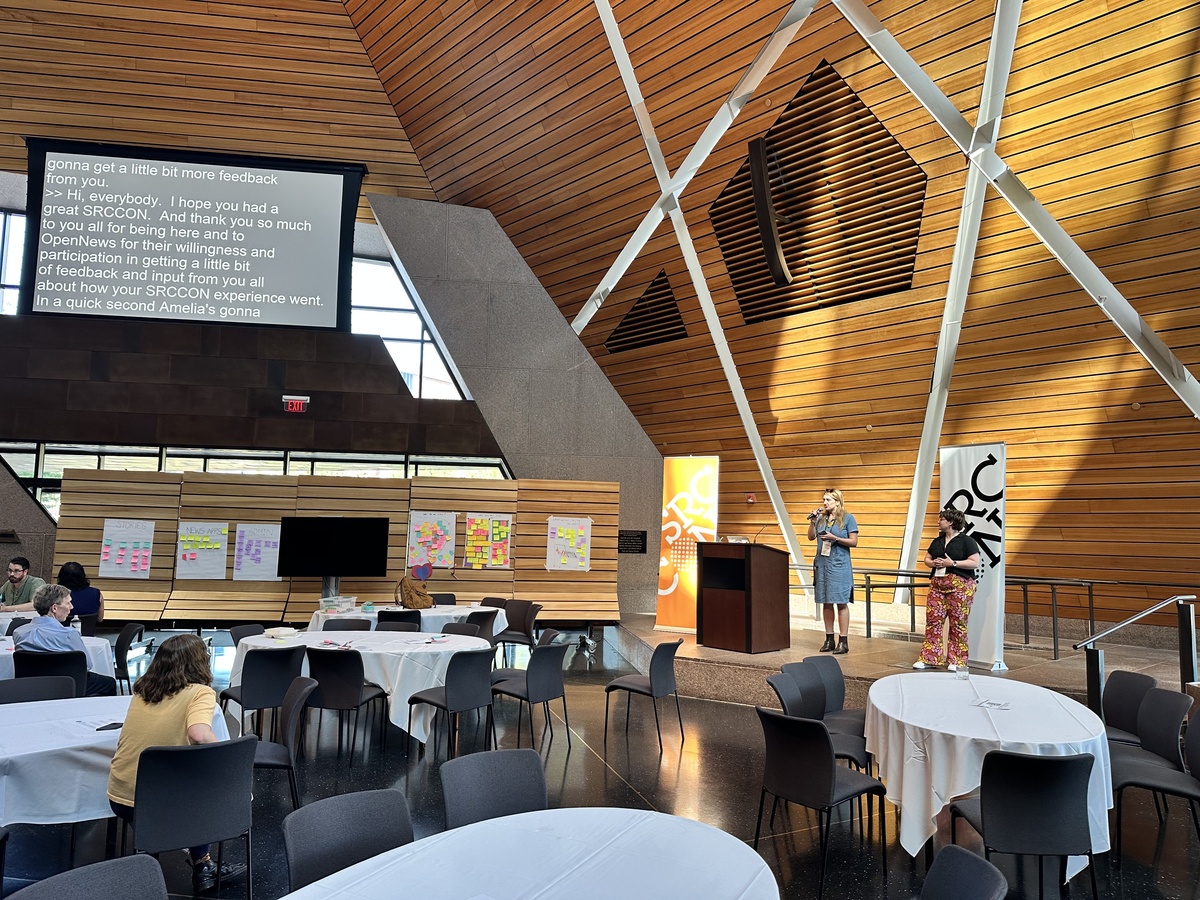
Madison Karas and Emilia Ruzicka introduce the live poll to SRCCON attendees. (Image credit: William Lager)
In March, we wrote that our gatherings could be so much better. Most run on assumptions about who is in the room and what would benefit them, and those assumptions rarely get tested.
The gatherings we want are ones where organizers and participants work from the same picture of the room, in the room itself, and where the event can be measured against what people said they came for.
After-event feedback surveys can only do so much here. They rarely surface the discrepancy between the expectations people had and the ones that were met, or whether anyone found the event useful compared to what they wanted out of it. They’re private only to the organizers, so the participants themselves don’t know how the event fared collectively. There is often a self-selection problem baked in as well, favoring the super-fans and the super-detractors while the middle of the room moves on without commenting.
Getting an up-to-date read on who is in the room, what they’re coming in with and what they want is relatively easy, inexpensive, and really interesting. It is mostly a matter of asking participants earnestly from the stage.
At SRCCON in Minneapolis this July, we got to run a small test. With the OpenNews team’s support, we ran two anonymous live polls: one during the opening session on the first morning, and a second at the closing session the next afternoon.
We came up with the questions, and OpenNews provided feedback and added a few they were curious about (such as asking about preferences for alternative conference locations next year).
Attendees could answer on their own devices, and the responses were projected on large screens in a communal space in real time. Out of roughly 200 at the event, 94 people answered the opening poll, and 69 answered the closing one. The results were up where anyone could see them while there was still time to respond, which brought moments of reflection, anticipation and laughter.
It takes a certain amount of courage for organizers to do this. You are asking your community to see each other, where they are coming from, and what they want from the space they are in, publicly, on day one, knowing the event will be measured against those answers a day later. We are grateful to the OpenNews team for saying yes and committing to the vulnerability of this experiment. Here is what came back.
Who was in the room
Nearly half of attendees responded: 94 answers on the first morning is roughly half the room, and 69 on the last afternoon is about a third.
We all discovered who was in the room: it skewed senior. About three quarters of those who answered the career question had eight or more years in the field. A third were at SRCCON for the first time. Just over half were not funded by an employer to be there. They paid their own way or came on a travel scholarship. When most of a room is spending its own money, or a scholarship’s, the bar for what the event owes them is higher.
What the room says it needs
Before asking anything about SRCCON, we asked what people would appreciate more help with in their work generally. Nothing in the question mentioned a conference.
Determining strategy or methods led, at 50 percent of those who answered. Then three answers that are all versions of the same thing: feeling less alone in the work and finding peers, 49 percent; feeling inspired during difficult times, 49; networking and understanding the industry, 48. Advancing in a career, 41. Challenges inside their own organization, 29. Choosing or learning tools came last, 23.
That list is a great standing brief for anyone building a conference program, and it belongs to the field rather than to any one event.
What people came for, and what they left with
In the morning, we asked everyone to pick three things they hoped to get out of SRCCON specifically. Learning new ways to approach their work led, at 71 percent of respondents. Then finding new sources of inspiration, 63, and meeting people with the same interests, 55. Learning about new tools came second to last, 21.
At the closing session, we asked what people got and the order shifted. New peers, friends or connections came first, at 89 percent. Sources of inspiration second, 68. New approaches and methods third, 52. Tools were again near the bottom, 14, and career advancement, already a minor hope in the morning, barely registered as an outcome, 9.
Side by side, the snapshots say something journalism conference programs are rarely built around: people arrive saying they want methods and leave with greater social bonds. The sessions matter, but for many they are just the occasion. The outcome is who you met and who you reconnected with.
Both polls were anonymous, so these are two snapshots of the room rather than the same people answering twice. This was not a scientific panel study. Both polls did ask the same questions about who was answering, and the two groups were indistinguishable on the demographic markers we had, so it’s relatively easy to do anonymous cross-comparisons without gathering personal data: first-timers 35 percent and 34 percent, eight or more years in the field 74 and 76, not employer-funded 56 and 63.
One item is worth reading across all three questions. Advancing in a career is what 41 percent of the room said they want help with. Only 28 percent hoped SRCCON would supply it. 9 percent said it did. People arrive already discounting the event on one of the things they say they need most, and over the two days the gap widens rather than closes.
We do not know why. SRCCON does not promise career advancement, and people who have been before know what it is for, so a low expectation may be an accurate reading of what is on offer rather than a disappointment. It is also possible that people have stopped believing any gathering can help them advance, at a point when “still be employed” is what they write about the year ahead. Those are different situations with different responses, and a poll like this cannot tell them apart.
What it can do is surface the gap early enough to ask about it. That is perhaps a question for SRCCON to look into before the next one, and a useful thing for any organizer to be upfront about. An event that does not intend to do career work can say so plainly and point people to where that work happens instead. An event that wants to take it on now knows how far it has to travel.
In their own words
The free-text answers on day one explain a lot. We asked what people wished others knew about their work this year. The answers were blunt: “We need money.” “Burnt out!” “The job market sucks.” “Moral injury looks like burnout but needs different care.” “I started a news outlet! Help!” When asked what they hoped to be able to do a year from now, people wrote “still be employed,” “be financially stable,” “have fun again,” and “feel proud of the work I’m doing again.”
We also asked, with no options to pick from, what people hoped they could do by the time SRCCON was over. On day two we asked what important thing had happened to them. Unprompted, in their own words, they produced the same shape as the multiple choice. Mentions of connection and people doubled, from 30 percent of day-one answers to 62 percent of day-two ones. Career and jobs shrank from 14 percent to 6.
The addition was getting some rest. Gatherings can be exhilarating but also tiring. Nearly a fifth of the day-one answers asked for a nap. “Rest without guilt.” “exhale.” “Take a nap.” “sleep!!!!!!” Almost none of the day-two answers mention it.
We do not know whether people stopped thinking about it once they were among peers, or whether two days is simply not long enough to catch up on any of it. But other answers in the day 2 live poll gave us some hints.
The closing picture
When asked to describe SRCCON in a word for friends and colleagues by the afternoon of day two, people wrote “restorative,” “worth it,” “a deep breath,” and several variations too profane to headline, in good ways.
When asked what important thing happened to them, the answers were almost entirely about people. “I met someone I’ve wanted to meet for a long time.” “Inspired to not yet rage quit.” “I was just a journalist for two days.”
The things people said were missing were concrete and cheap: breakfast and more protein at lunch, by far the most frequent; lightning talks; unconference sessions; technical workshops; more evening activities; and a third day. Requests like these usually reach an organizer weeks later from an inbox. Here they arrived at once, in the room, where everyone could see how many other people wanted the same thing.
The poll also did a piece of ordinary practical work. When asked where SRCCON should be hosted in 2027, the room split almost evenly: Philadelphia 33, Milwaukee 32, Kansas City 11, and 12 votes for somewhere else. That is a decision the organizers now get to make with their community rather than for it.
None of this is a verdict on SRCCON. The exercise showed organizers who embraced the reality of their attendees’ lived experience and let everyone else see it, too. Attendees told us afterwards that “it was fun watching our opinions come through live and seeing how what I thought sometimes resonated and sometimes didn’t.”
The point is that organizers now know that reality from their own community’s answers rather than from a satisfaction score or hallway anecdotes (meant to be shared with donors), and the community knows it, too.
Where this sits alongside what organizers already do
Level-setting is not new at SRCCON. OpenNews reads what people write in the calls for participation, adds what the team knows from working in the field, and says out loud at the welcome what the community is grappling with and what kind of space the event can be. This year, the welcome carried a lot: OpenNews turning 15, a new advisory council, and a programme built around bearing witness to the plight of immigrant journalists in Minneapolis, caring for mental health as journalists, and finding joy where it can be found.
So the poll was one element inside an opening that already did this work, alongside a pre-event call for participation and a post-event survey that both shape how SRCCON gets designed. What it added was a way to do the grounding with the room, at the moment the room was assembled, in numbers everyone could see. Many gatherings have no equivalent opening ritual to build on.
If yours does not, this is a cheap way to start one.
Why we think you should try this
A live poll measures something a post-event survey cannot reach, and it does three things we saw work at SRCCON:
-
Everyone sees the same numbers at the same time. When the room can see that just over half of the people answering are not employer-funded, or that feeling less alone ranks alongside determining strategy as what people want help with, that information stops being the organizers’ private property. Whether it changed any hallway conversations, we have no way of knowing. It was at least available to change them, at a point in the event when that was still possible.
-
It measures against expectations rather than against nothing. A closing live poll that asks how it was can only collect vibes. Asking the same room a comparable question at the start and at the end shows movement: what was hoped for, what was delivered, what was missed. Our own comparison was rougher than it should have been, because the option wording drifted between the two polls.
-
Anonymity and immediacy get you different answers. “Burnt out!” and “The job market sucks” are answers people are far more likely to give when there is no name field, and they might see others expressing the same thing.
With further development, this could also be a tool for organizers to use at the beginning and throughout a conference to real-time adapt programs and activities to participants’ needs in the moment.
How to run one
The mechanics are simple, and any organizer can do this.
-
Run two short polls, opening and closing, five to ten minutes each, on stage.
-
Ask a few multiple-choice questions about who is in the room: career stage, role, how the trip is funded, first time or not.
-
Ask a pick-three question about hopes at the start, mirrored by a pick-three about outcomes at the end. Use the same options, worded identically.
-
Ask at least one question about what people need in their work generally, with no mention of the event. It is the most reusable thing you will collect.
-
Add a handful of open prompts. They are where the findings you did not anticipate come from.
-
Keep it anonymous.
-
Show the results live.
A couple things we would do differently: 1) keep the question count down, because completion dropped through the later questions and 2) build in a moment on stage to talk about what the numbers show, rather than letting them scroll past.
If you organize a gathering in journalism, or know someone who does, we would love to help you run this. The questions, the format, and everything we learned are yours for the asking. Write to us at better-gatherings@gazzetta.xyz.
Our gatherings could be so much better. Live polls are one cheap, fast, and fun way to start.
Credits
-
Patrick Boehler
Patrick Boehler has accumulated more conference lanyards than he'd like to admit. He runs Gazzetta, a media research lab studying how people access information in restrictive environments, and writes the re:filtered newsletter. Before that, he spent years as a reporter, editor, and newsroom manager in Asia and Europe. He lives in Brooklyn and is trying to attend fewer panels.
-
 Madison Karas
Madison Karas is the Lead for Service Design at Gazzetta. She works on product and research initiatives for independent media organizations and has spent a lot of time in startups and too much time at conferences. She is exploring how service design, cooperative models, and more robust contribution systems can build a better, more intentional future for journalism producers and consumers.
-
Emilia Ruzicka
Emilia Ruzicka is a freelance data journalist. They work part-time managing data for the Trans News Initiative, conduct accessibility trainings with Equal Access Public Media, and were formerly a Data Reporter at Stacker. They have published with the Urban Institute, the Center for News, Technology, and Innovation, and other outlets. Emilia has an MA from University of Virginia and a BS from Brown University. For more, visit emiliaruzicka.com.

 We asked a whole journalism conference what it wanted, out loud