
Search Source
-

Project Diary: How we made the Wage Theft Monitor
By Max Siegelbaum
Posted onHow Documented fought for data about businesses that have stolen from their workers, and what you need to know to do this kind of project in your state.
-

How We Visualized the Challenges and Limitations Facing Autonomous Cars
By Chris Alcantara, Youjin Shin, and Aaron Steckelberg
Posted onHow we reported and developed our own visual story to show the public how an autonomous car sees, thinks, and operates—in sometimes unexpected ways.
-

Things You Made, Sept 13
By Lindsay Muscato
Posted onOur regular biweekly roundup.
-

How We Made a Human-Centered Homicide Report
By Lindsay Muscato
Posted onA Q&A; with the team behind Houston’s first homicide report, a cross-team collaboration that altered how different areas of the newsroom worked together.
-

How We Made the Force Report Database
By Carla Astudillo and Erin Petenko
Posted onHow we made a database of every time N.J. cops punched, kicked, or used other force over a five-year period, and a series of stories to go with it.
-

New Open Source Tools for Journalism Educators
By Allison Lichter Joseph
Posted onTools and resources, including a cool deck of cards, to teach journalism or just get yourself out of a rut.
-

Mapping the Fiery Chaos of the 1968 Riots
By Armand Emamdjomeh, Danielle Rindler, and Lauren Tierney
Posted onA full walkthrough of the Washington Post’s mapping project involving D.C.’s 1968 riots.
-

How We Made “Billions of Birds Migrate”
By Brian Jacobs
Posted onNational Geographic’s enormous bird migration interactive and how it came to be.
-

How We Made “Sending Even More Immigrants to Prison”
By Yolanda Martinez
Posted onA data project that shows how the U.S. government has prioritized immigration deterrence and criminalization.
-

How We Made the New Big Mac Index Interactive
By Martín González, Evan Hensleigh, Matt McLean, Marie Segger, and Alex Selby-Boothroyd
Posted onA walkthrough of making an iconic index new again.
-

How We Made the “Bundyville” Podcast & Series
By Leah Sottile
Posted onThe long road to a series and a podcast, as a solo journalist.
-

How We Made Our “Crossing Divides” News Game
By Luke Hutton, Fionntán O’Donnell, Pietro Passarelli, and Alli Shultes
Posted onHow we made a chat-based game that aimed to bridge social divisions.
-

How We Made Unequal Justice
By Ann Choi, Erin Geismar, James Stewart, and Will Welch
Posted onOur two-part series that painted a picture of disparate justice systems on Long Island depending on race or ethnicity.
-

How We Made “The Melting of Antarctica”
By Lauren Tierney
Posted onFor over 120 years, National Geographic magazine has mapped Antarctica, and continues to visually illustrate the complex processes that occur on this remote continent. The tradition continues with “The Melting of Antarctica,” published in the July 2017 issue, highlighting the effect that climate change is having on the continent.
-

Our Font Is Made of People
By Alberto Cairo and Scott Klein
Posted onAll about ProPublica’s new Wee People font of human silhouettes, free for all to use.
-

How We Made Our School Segregation Interactive
By Alvin Chang and Erin Kissane
Posted onWe really appreciated Vox’s recent illustrated interactive on school segregation and gerrymandering—particularly because its creator, Alvin Chang, worked alongside Tomas Monarrez, a UC Berkeley economics PhD candidate.
-

How We Made “The Year in Push Alerts”
By Holly Allen, Laura Bennett, and Andrew Kahn
Posted onA few weeks ago, Slate published a year-in-push-alerts feature that captured much of the sense of escalating anxiety and unreality produced by the last year in breaking news.
-

How We Made “The Water Drain”
By Lindsay Muscato and Cecilia Reyes
Posted onTo piece together the bigger picture of water usage and how much people pay, the Tribune team used a variety of data sources, including their own survey. They found wide disparities in what residents were paying for water, with the poorest communities paying the most.
-

Five Years, What a Surprise
By Erin Kissane
Posted onHow we made Source, and why, and what happened then.
-

Visualizing Mass Shootings
By Erin Kissane and Lindsay Muscato
Posted onOver the past two years or so, we’ve kept tabs on our community’s work around guns in America. We’ve seen a wealth of data visualizations and a huge breadth of interactive projects that bring clarity to stories of gun violence and mass shootings—projects often assembled quickly amidst the chaos of breaking news.
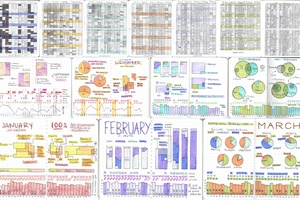 Data by hand: Analog datavis & self-reflection